
Aged care workers report persistent staffing and safety concerns
Almost all survey respondents said they had either experienced or observed workplace violence and aggression in the last year

A national survey of aged care nurses and care workers has raised fresh concerns about staffing levels, workplace violence and financial transparency across the sector, despite the reforms introduced following the Royal Commission into Aged Care Quality and Safety.
The Australian Nursing and Midwifery Federation’s (ANMF) Pulse Check of the Aged Care Sector: The Real Impact of Reforms surveyed over 3500 aged care workers across Australia, including registered nurses (RNs), enrolled nurses (ENs) and personal care workers. Most respondents worked in residential aged care and more than half had over a decade of experience in the sector.
Almost two in five respondents (39.71 per cent) rated staffing levels at their workplace as “poor” or “very poor”, while 47.52 per cent said the ratio of nursing staff to care staff was inadequate. Almost half of workers (49.03 per cent) also reported having insufficient time to provide care to residents.
Responses from workers employed by for-profit providers were generally more negative across staffing-related measures.
ANMF federal secretary Annie Butler said the results provided “a wake-up call for everyone in aged care”.
“We simply can’t assume that aged care is fixed,” she said.
“The lived experience of frontline nurses and carers shows these reforms may have led to some welcome improvements (such as RN 24/7), but they certainly haven’t gone far enough to fix a broken system.”
The survey found RN staffing was viewed more favourably than other workforce groups, but respondents reported significant concerns about the number of ENs and personal care workers available.
More than 44 per cent rated EN staffing as inadequate, while 41.35 per cent reported insufficient numbers of personal care workers.
The Federation has argued that their findings suggest recent reforms, including mandatory care minutes and 24/7 RN coverage, have not fully resolved underlying workforce pressures.
“It’s clear that serious systemic problems still persist, including poor staffing ratios, caring for large numbers of residents with minimal staffing and support, which is impacting the ability to deliver high-quality care, with understaffing also leaving nurses and carers open to physical, verbal and emotional violence,” Ms Butler said.
Workplace violence widespread, recurring
The worrying rate of workplace violence incidents across the sector is one of the survey’s most significant findings.
Almost all respondents (96.43 per cent) said they had either experienced or observed workplace violence and aggression during the previous 12 months.
More than three-quarters reported experiencing verbal abuse, while almost 70 per cent reported physical aggression. Just under half reported property damage or thrown objects, while more than one-third reported racism and sexual harassment.
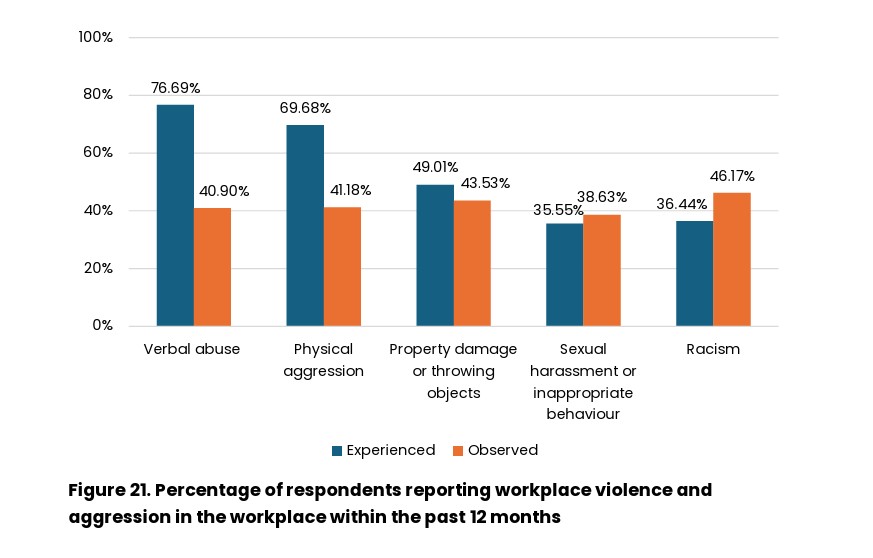
The survey found workplace violence was not only widespread, but often recurring. Among workers who experienced verbal abuse, more than half reported it occurred daily or multiple times each day.
Furthermore, workers who rated staffing levels as “very poor” were more likely to report experiencing violence and aggression than those who considered staffing levels adequate, suggesting a relationship between workforce shortages and the prevalence of incidents.
“There are never enough staff to manage all behaviours from residents. They have to be unsupervised to provide appropriate care to all others.” – Survey Respondent
Residents were identified as the primary perpetrators of most incidents, however, workers also reported experiencing aggression from residents’ family members, visitors and, in some cases, other staff and managers.
Family members were frequently identified as sources of verbal abuse and racist behaviour towards staff.
The ANMF said inadequate staffing reduced workers’ ability to supervise residents, identify risks early and safely respond to challenging behaviours.
“To finally fix the problems, we need structural changes that address workforce shortages and skills mix and provide stronger protections for staff facing daily workplace violence and aggression,” Ms Butler said.
The report suggests violence and aggression are often linked to organisational factors as well as resident needs.
Respondents described situations where residents with complex behavioural needs were left unsupervised because staffing levels were insufficient, increasing the risk of incidents. Others reported a lack of behavioural support plans, inadequate risk assessments and limited preventative measures to reduce the likelihood of aggression occurring.
Management responses were also an issue for survey participants. More than 41 per cent of respondents rated management support following incidents of violence and aggression as “poor” or “very poor”.
Workers reported a culture in which abuse was frequently dismissed as “part of the job”, with some respondents claiming incidents were under-reported because staff did not believe meaningful action would follow.
“Management say that’s just what the residents do and there’s nothing you can do about it. You’re made to feel guilty if you refuse care due to threats of violence, refusal of care, or verbal abuse…” – Survey Respondent
The ANMF said the findings demonstrate the need for stronger protections for workers, including nationally consistent training, improved risk assessment and care planning, stronger incident reporting systems and a sector-wide “zero tolerance” approach to workplace violence and aggression.
Calls for greater accountability
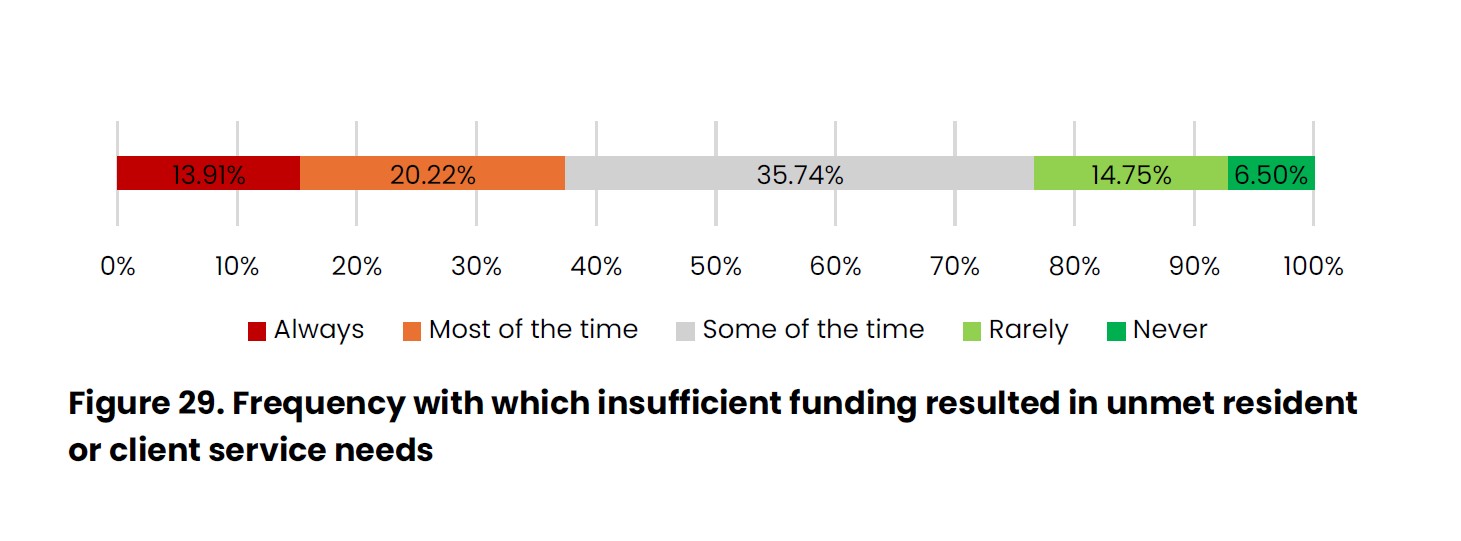
Financial accountability also emerged as a recurring theme. According to the survey, 20.22 per cent of respondents said a lack of funding or budget constraints meant residents did not receive the services they needed most of the time, while a further 35.74 per cent said this occurred some of the time.
Respondents reported concerns about providers failing to replace sick staff, limiting the use of agency workers and rationing resources such as wound dressings and equipment upgrades as cost-saving measures.
The report noted respondents working for for-profit providers consistently reported higher dissatisfaction with staffing and were more likely to experience workplace violence and aggression.
The report’s findings give weight to concerns raised by the ANMF when it announced the survey in October.
At the time, Ms Butler said members continued to report understaffing and unsafe workloads despite reforms introduced following the aged care royal commission and warned that some providers were manipulating staffing arrangements and care-minute reporting requirements.
The survey was launched as a national “pulse check” intended to test whether reforms were translating into better conditions on the ground.
Ms Butler said the survey findings demonstrate many of those concerns remain unresolved and that stronger accountability measures are needed to ensure government funding translates into improved care outcomes.
“The federal government invests more than $25 billion in residential aged care but we are not seeing the return on this investment,” she said.
“To make sure older Australians are receiving safe and dignified levels of care, the ANMF recommends transitioning from the current care minutes system to mandated staffing ratios and skill mix requirements. Mandated staff-to-resident ratios across all shifts would provide a clearer, more enforceable standard and importantly, reduce the potential for the manipulation of care minutes reporting by some providers.
“Ultimately, the quality of Australia’s aged care system depends on the strength and resilience of its workforce. By implementing these recommendations, we can work with the federal government to build a sustainable, accountable and high-performing aged care system that better supports nurses and carers and delivers safe, person-centred care for residents now and into the future.”
Email: rebecca.cox@news.com.au